Walk into any yarn department or store and the variety of yarns and colors will amaze you. Beautiful textures, interesting fibers and exciting blends are now available along with classic, traditional yarns.
Most yarn companies provide pattern books, leaflets and even pattern ideas right on their labels. These patterns give you a good idea of how a yarn is crocheted or knitted to best advantage. Generally, projects with intricate stitch patterns are not shown in highly textured yarns because the stitch detail would be lost. The beautiful texture of these yarns is what you want to show.
To help you better understand what these new yarns look like, following is a brief look at some of the more popular new yarn types. Keep in mind that some new yarns are combinations of one or two types such as eyelash yarn mixed with ribbon yarn.
When working with highly textured yarns, remember to count your stitches often because it is easy to miss a stitch or make two stitches in one. When ripping out textured yarn, do it slowly so as not to break the yarn. And when making a garment with a highly textured yarn, if you have difficulty joining seams, try substituting a smooth yarn in a matching color.
For more details about yarns and other helpful information, read: Passion for Knitting by Nancy J. Thomas and Ilana Rabinowitz published by Simon & Schuster and Knitting with Novelty Yarns by Laura Militzer Bryant and Barry Klein published by Martingale & Co.
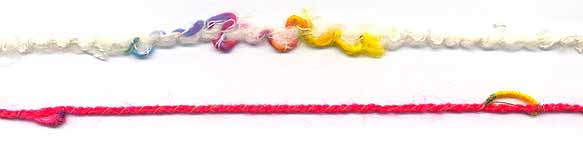
Boucle Yarns
Loops are created on a base fiber of boucle yarns. The size of the loops and the distance between loops can vary greatly.

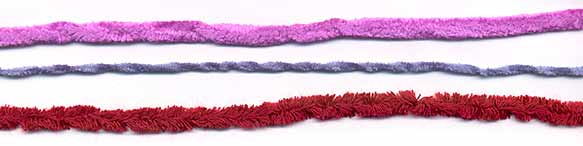
Chenille Yarns
Chenille yarns have a center fiber that locks threads in place creating soft piles of fiber on either side of the base fiber. When knitted or crocheted, the fabric resembles velvet or velour.
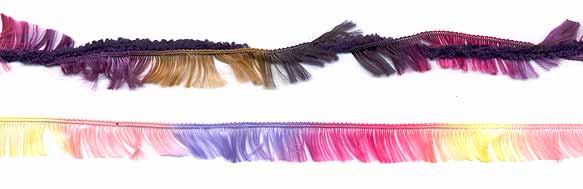
Eyelash or Fur Yarns
Strands of yarn stick out from a core fiber to create eyelash yarns or fur yarns. Depending on how close and long these strands are, the yarn can appear furry.
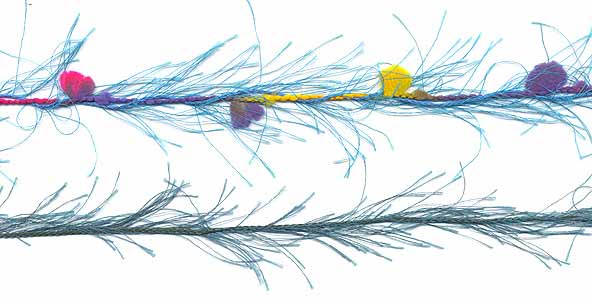
Brushed Yarns
A variety of yarn types and fibers can be brushed to give a fuzzy appearance and soft feel, simulating the look of such natural fibers as mohair.
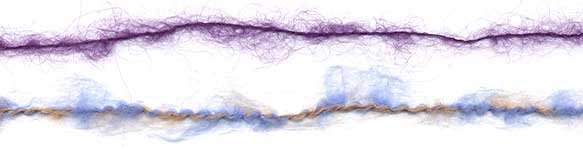
Thick and Thin or Home Spun Looks
Certain sections of the yarn are spun more tightly than others to create a thick and thin appearance. Thick and thin yarns often have a home-spun look and are usually quite bulky.

Ribbon Yarn
Woven or knitted ribbon yarn come in a wide variety of widths and fibers. Their flat surface "crinkles" when knitted or crocheted, creating interesting textures.

Ladder Yarns
Two base fibers are joined at spaced intervals by strands of yarns, creating "steps." Ladder yarns come in a variety of widths and the spacing of the "steps" can vary greatly.

Metallics Lames or Lure
Shiny effects in metallic lame or lure yarns can be achieved using real metallic fibers but most commonly, shine is achieved with strands of plastic or synthetic filament, which are light weight and soft to the touch.

Nubby or Slub Yarns
As a yarn is spun, the machine periodically twist the yarn creating nubs (sometimes called slubs) on the surface. Nubs can be placed close together or far apart.